The Method · A true story
The Harada Chart
A 64-square sheet of paper that turned the worst sports team in Osaka into national champions - and later guided a teenager named Shohei Ohtani to the top of world baseball.
#1
from the worst of 380 city schools
13
national gold medals won
90k+
people trained in the method
280+
companies, incl. Toyota & Panasonic
01 - Origin
Osaka, 1990s
In the early 1990s, Takashi Harada took on one of Japan's most thankless coaching jobs: the track and field programme at a junior high school in Osaka's most deprived neighbourhood - the worst-performing school out of 380 across the city. His students had little confidence, poor discipline, and almost no belief they could amount to anything.
Rather than drilling harder technique, Harada focused on something nobody else was measuring: the students' inner world. He asked each athlete to define a single "highest goal," map their strengths and weaknesses honestly, design daily routines tied to that goal, and keep a journal. Then he added a fourth dimension that proved decisive - actively helping others every single day. Physical skill, self-belief, good habits, and service to others together formed his framework.
Within three years the team won the regional championship and held it for six years running. Twelve of his athletes won thirteen national gold medals, making their school the best in Japan for its age group. Nearly all of his once-struggling students earned university scholarships.
02 - The tool
The Open Window 64
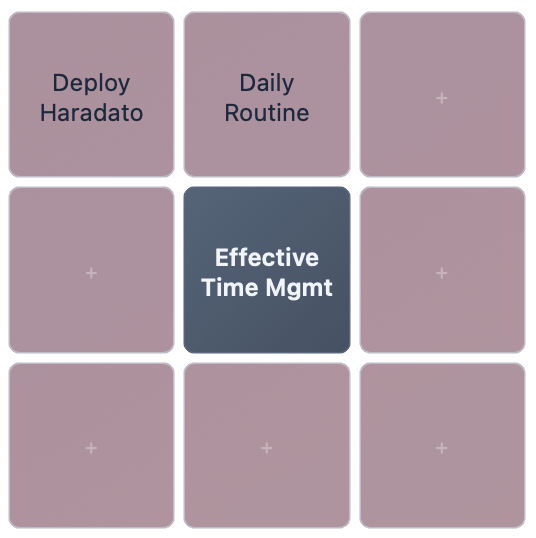
To make the system teachable and visual, Harada devised a tool he called the Open Window 64 - a 9×9 grid. A central life goal sits in the middle, surrounded by eight pillars of development. Each pillar anchors its own 3×3 block of eight concrete sub-goals, giving 64 total action items.

One central goal
Concrete, measurable, and meaningful enough to sustain years of effort.
Eight pillars
The domains you must develop - physique, technique, mentality, character.

Sixty-four actions
Eight repeatable daily behaviours per pillar that build each one over time.
The chart's power is its visibility. Everything you need to do - across every dimension of growth - fits on a single page. Nothing is hidden in a buried notes file or a forgotten app. You can see at a glance where you are thriving and where you are falling short.
03 - Scale
From the classroom to the boardroom
After his success in education, Harada left teaching in 2002 to take the method into the corporate world. The same principles - self-reliance, structured goals, daily discipline, and service to others - that transformed struggling teenagers, he reasoned, would work for adults in organisations.
He was right. The method was adopted by Toyota, Panasonic, and Suntory, and has since been taught to over 90,000 people at more than 280 companies. The Japan Management Association called it "the world's best system for developing people to their fullest capabilities."
It reached the West through Norman Bodek - the publisher known as the "Godfather of Lean." Having long felt Lean manufacturing was missing a human dimension, he called the Harada Method "the human side of Lean" and spent his final years bringing it to North America and Europe.
04 - The legend
Shohei Ohtani's chart
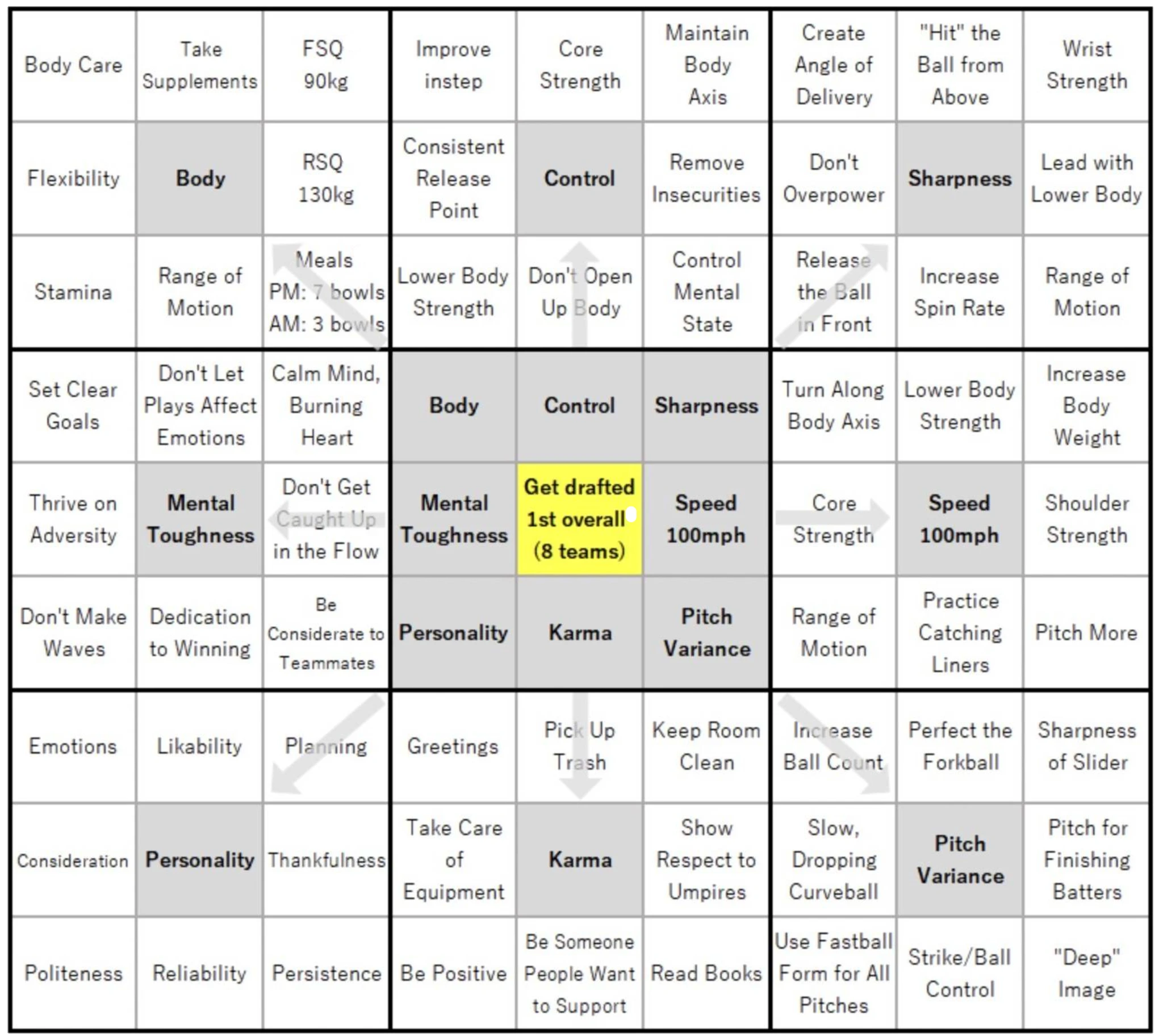
In 2010, a fifteen-year-old from Iwate Prefecture enrolled at Hanamaki Higashi High School, whose baseball coach, Hiroshi Sasaki, required every player to complete an OW64 chart. That student was Shohei Ohtani. At the centre of his grid he wrote a goal that seemed audacious even for the most talented prospect in Japan:
"Be selected No. 1 in the draft by all eight NPB teams."
Around it he arranged eight pillars: Physique, Control, Sharpness, Speed, Pitch repertoire, Character, Mental toughness - and, famously, Luck. The luck column became the most discussed part of the chart. Ohtani's eight "luck habits" were entirely mundane acts of character:
- Pick up litter on the field
- Bow to umpires and opponents
- Greet everyone with energy
- Be someone others want to support
- Keep the locker room spotless
- Thank the bus driver
- Read a book every two weeks
- Write thank-you letters
His reasoning, repeated in interviews: "If you become the kind of person people want to see succeed, the universe finds a way to help you."
In 2012, every single NPB team did try to draft Ohtani first overall. By 2018 he was in Anaheim rewriting what a baseball player could be, and in 2024 he became the first player in history to hit 50 home runs and steal 50 bases in a season while pitching triple-digit heat.
05 - The insight
Why it works
The Harada Method refuses to separate skill from character. Ohtani's chart is explicit: cleaning the dugout and reading books sit alongside pitching mechanics and strength targets as equal contributors to success.
"People fail to reach their goals not because they lack ability, but because they set and pursue those goals the wrong way." - Takashi Harada
World-class success, the method argues, is the accumulated residue of world-class daily habits. The fastest way to install those habits is to make them visible, countable, and tied to a purpose bigger than ego.
The chart, as a living system
Bring your Harada chart to life
Haradato puts the OW64 chart on your phone and the web - and adds what paper can't: a real to-do list and notes behind every one of your 64 squares.
- One central goal, visible every time you open the app
- 8 pillars and 64 sub-goals on one interactive grid
- Tasks and markdown notes attached to every cell
- Progress at a glance - and synced across all devices